
A Guide
Getting Started
FIRST STEPS WITH HANUMAT
This page is a guide for those opening Hanumat for the first time. Entering the birth data, casting a chart, following the dashas — it is written so that the whole sequence can be traced, in order, screen by screen. The more intricate matters of configuration are gathered toward the end; for now, with no haste, go only as far as a single chart standing on the page.
Interpretation remains the art of the astrologer; the software only sets the board. What follows is simply a quiet account of how that board is set.
Hanumat runs within the browser. Nothing need be installed; open the address below and it is ready to use. It works on a phone as well, though the close reading of a chart is better suited to the wider screen of a desktop.
The first task is to enter the birth data. The date, the time, and the place of birth — once these three are in hand, the chart will stand.
Give the time as precisely as you can. A single minute can unsettle the ascendant and alter the divisional charts. The place may be found by name; latitude, longitude, and time zone are supplied automatically.
For births in earlier eras — before modern standard time was fixed — use the LMT (local mean time) checkbox. The calculation then follows the time given by that place’s own sun. The time zone is detected automatically as well, but in historical cases it is wise to confirm it once by hand.
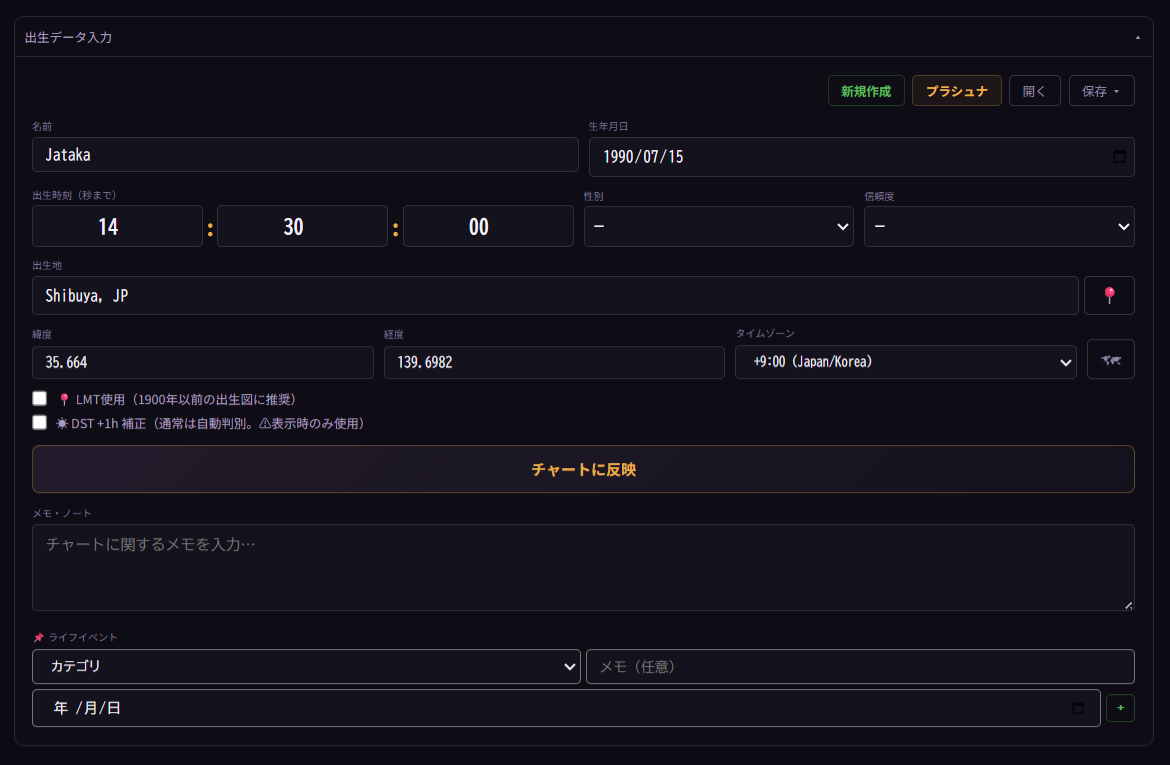
Once the data is entered and the chart created, the Rashi (D1, the base chart) appears. The planets are set into the twelve houses and the ascendant is marked. This is the point from which everything begins.
The chart style — North Indian or South Indian — can be switched between; set it to whichever you read most readily. Following the planets, observing the lords of the houses, regarding the relations of occupation and rulership — it is the board for that patient work that is being set here.
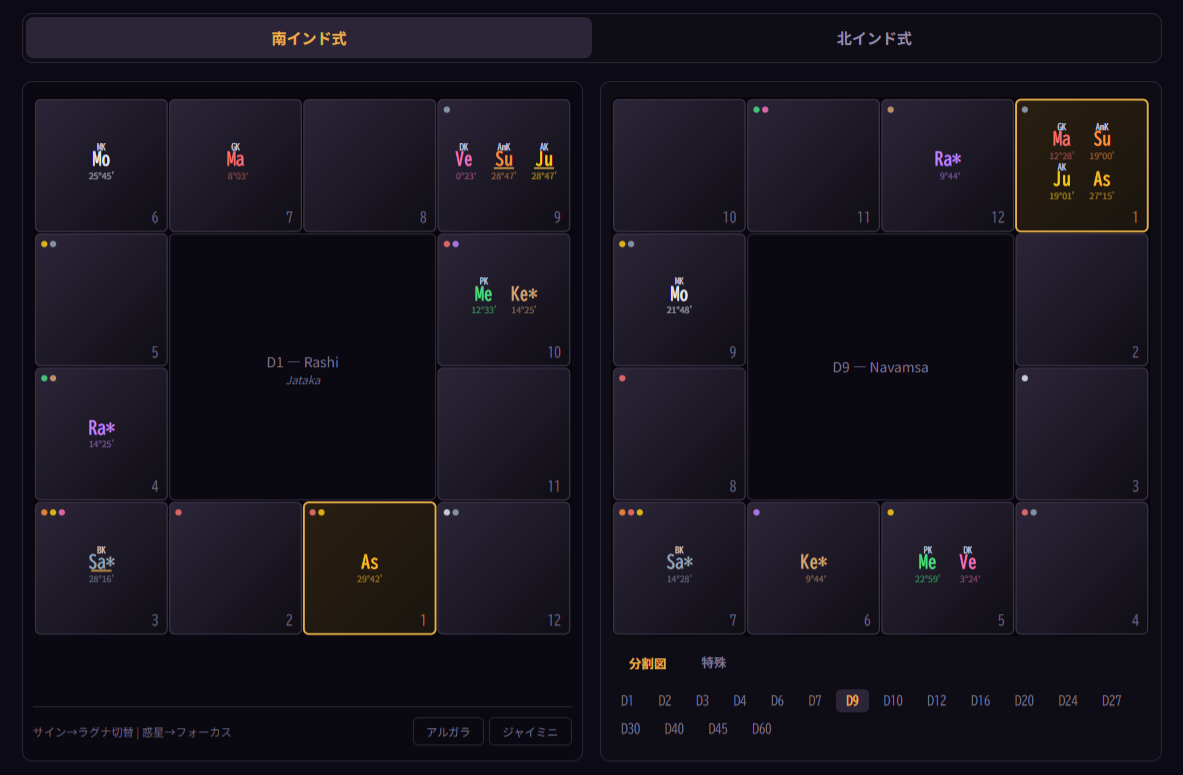
Once the base chart stands, one moves to the flow of time — the dashas — and to the divisional charts that bear upon particular themes.
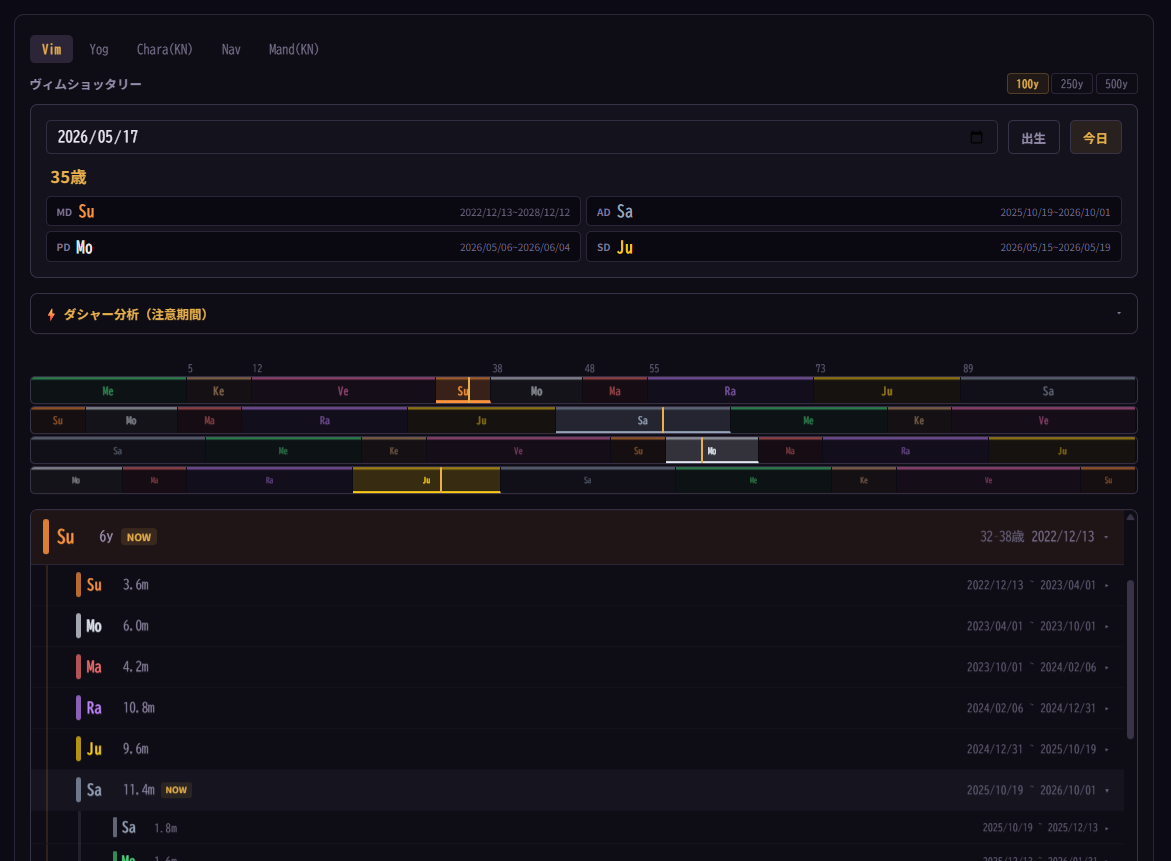
The several dashas, the Vimshottari among them, are shown as periods nested within periods, so that one can trace where one is looking — present, past, or future. The divisional charts, from D1 through D60, may be called upon as the matter requires: D9 for marriage, D10 for vocation, and so on.
The particulars of each are gathered in the Features. Here, first, simply take in the whole — the chart and the dashas seen side by side.
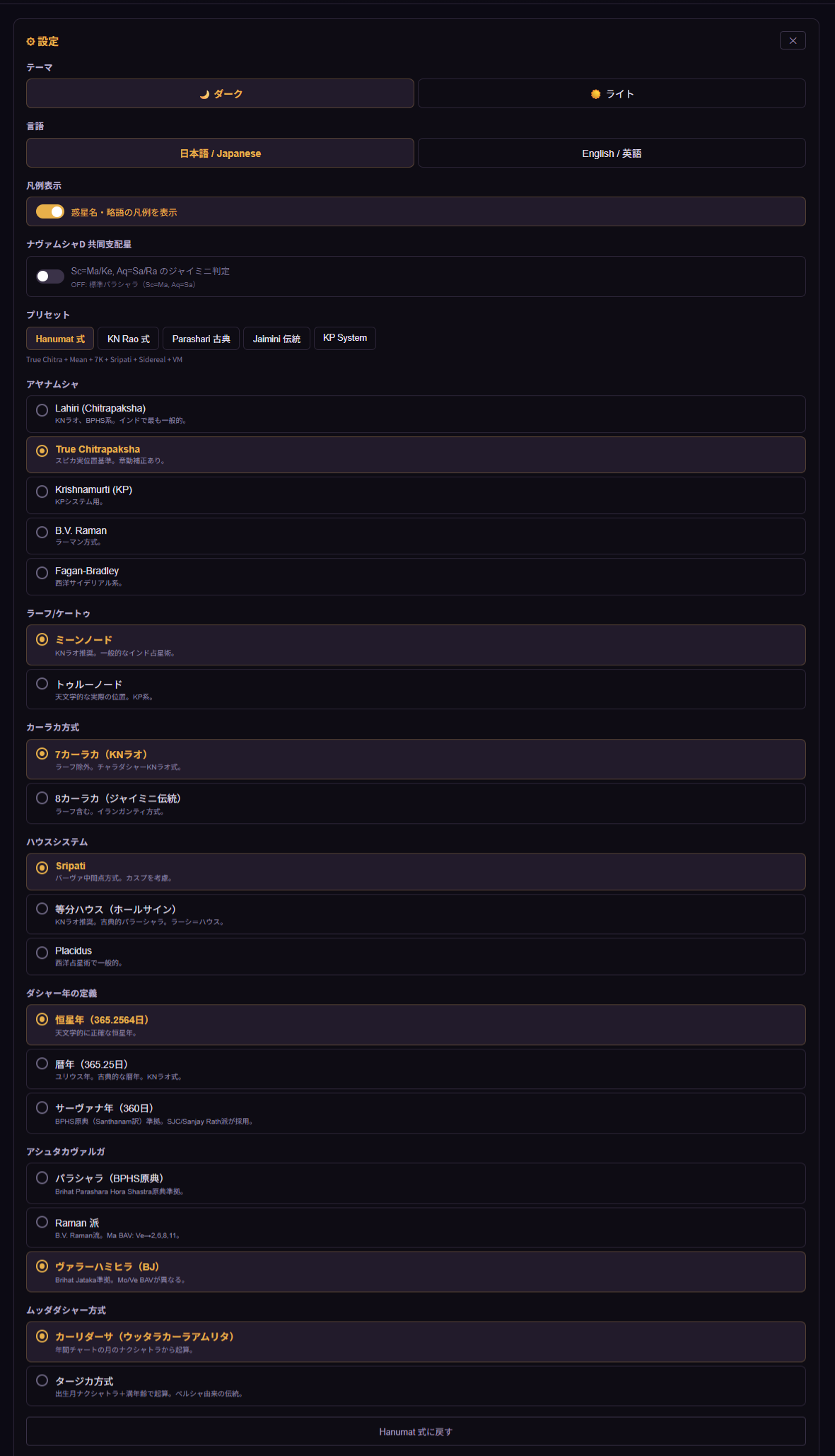
On the points where the traditions give differing answers, Hanumat leaves the choice to the settings.
The ayanamsha (how the vernal point is taken), the definition of the dasha year (the 360-day Savana year, among others), the chart style — the defaults are a practical combination in keeping with the tradition carried forward by Shri K. N. Rao, yet other premises may be tried for the sake of study.
Should it become unclear what has been chosen, returning to the preset (the defaults) brings the calculation back to firm ground. Finer points of configuration are touched upon as well in the Frequently Asked Questions.
When a calculation does not agree with another program, when the meaning of a setting is unclear, when you wish to know how a particular dasha or divisional chart is handled — such questions are gathered in the Frequently Asked Questions.
N.F. HASE
An instrument for the study and practice of astrology, offered freely — not for profit.